Home Saunas: The Complete UK Buying Guide for 2026
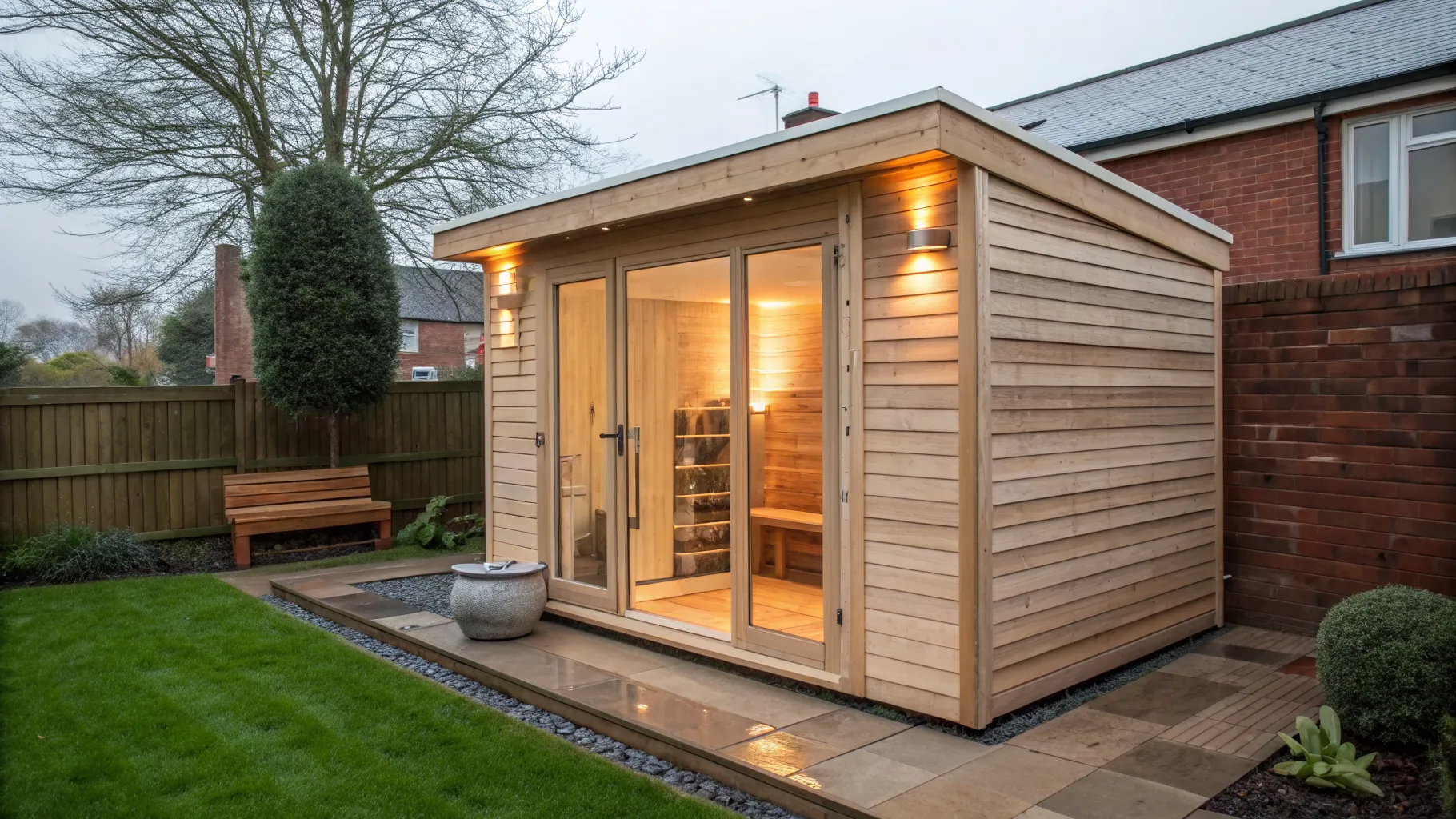
Saunas have stopped being a leisure-centre afterthought in the UK. People are putting them in spare rooms, garages and back gardens, partly for the recovery and relaxation claims, partly because a single outdoor cabin can become the best-used part of a property. The trade-off is that a home sauna is part appliance, part outbuilding and part electrical installation, so the decisions stack up fast: infrared or traditional, indoor or outdoor, what heater size, who wires it, and whether you need planning permission at all.
This guide pulls the cost, sizing, regulation and health facts into one place, with the UK rules competitors usually skim over. Prices move constantly, so check current figures on a retailer’s own product page before you commit.
The five ways to own a sauna at home
There is a wide gap between a fabric blanket and a bespoke garden cabin. Picking the right format first saves you from over-spending or buying something you will not use.
| Type | Typical capacity | Operating temperature | Rough position on cost |
|---|---|---|---|
| Sauna blanket | 1 person (lying) | Low, infrared warmth | Cheapest entry point |
| Portable steam (pop-up) | 1 person | Steam, head exposed | Low, can feel cramped |
| Infrared cabin | 1 to 2 people | 45 to 60C | Lowest-cost route into a fixed cabin |
| Traditional dry sauna (indoor kit) | 2 to 8 people | 70 to 90C | Mid to high |
| Outdoor cabin / barrel | 1 to 8 people | 70 to 90C | Highest, before bespoke |
Blankets and pop-up tents are the budget end and suit flats or anyone testing whether they will actually use heat therapy. Infrared cabins are the cheapest fixed option, run cooler, and many plug into a standard 13A socket, which is why they appeal to indoor and first-time buyers. Traditional dry saunas run far hotter and are what most people picture when they think “sauna,” but they need more power and usually more wiring work. Outdoor barrel and cube saunas are the premium choice and turn into a garden feature in their own right.
For a deeper buyer comparison once you have settled on a format, see our best home sauna UK roundup.
What a home sauna actually costs
The honest answer is a range, because “sauna” covers everything from a blanket to a timber cabin. Industry guidance puts most UK buyers in the low-to-mid four figures, with pre-designed outdoor saunas commonly landing in the mid four to low five figures, and bespoke builds running far higher.
Roughly, in ascending order:
- Sauna blanket: lowest cost.
- Portable steam sauna: still low, but more than a blanket.
- Infrared cabin (1 to 2 person): the cheapest fixed cabin route.
- Traditional dry sauna: starts higher than infrared.
- DIY indoor build, materials only (2m x 2m, 2 to 3 person): materials-only spend in the four figures.
- Outdoor barrel saunas: rise by capacity, from micro 1 to 2 person up to large 6 to 8 person.
- Outdoor cube saunas: compact 2 to 4 person units, rising to larger models.
- Outdoor cabin saunas: the top of the pre-designed range.
- Bespoke: open-ended, well into five figures.
Total cost of ownership, not just the sticker
A sauna’s purchase price is only part of the bill. For an outdoor unit, ground and foundation prep frequently adds a meaningful sum depending on your ground. Fixed electrical work for a traditional heater means an electrician and, where notification is required, a building control fee. Then there is the per-session running cost, which adds up over a year of regular use.
You can size two of those numbers before you buy with our sauna running cost calculator and sauna heat-up time calculator.
Infrared vs traditional: which suits a UK home
This is the decision that shapes everything else: power requirements, wiring, heat-up time and running cost.
| Infrared | Traditional (electric) | |
|---|---|---|
| Temperature | 45 to 60C | 70 to 90C |
| Heat type | Radiant panels warm the body | Hot air and steam (loyly) warm the room |
| Power supply | Often a standard 13A socket | Usually a dedicated circuit |
| Energy per session | Roughly 1.5 to 3.5 kWh | Higher; see running costs below |
| Best for | Indoor rooms, lower running cost, simpler install | The classic high-heat, steam-on-stones experience |
Infrared wins on install simplicity and running cost, which is why it dominates the indoor and budget-conscious end. Traditional wins if you want the full Finnish-style heat with the option to throw water on the stones. Neither is objectively “better”; it depends on whether you prioritise a plug-and-play indoor unit or the authentic high-heat session.
Running costs at current UK electricity rates
Per-session figures depend on your unit’s power and your tariff, but the published worked examples are consistent.
- Traditional 6kW electric: Which? estimates around 4 to 5 kWh in the first hour plus 3 to 4 kWh in the second, so roughly 7 to 9 kWh for a two-hour session. Finnmark puts a typical 6kW electric session at a similar level.
- Infrared: roughly 1.5 to 3.5 kWh per session, which lands well under the cost of a hot traditional session.
- Wood-burning: no electricity for the heat itself, but you are buying firewood per session instead.
A standalone traditional electric session is typically reported as the more expensive of the two, infrared lower, so over a year of regular use the format you choose has a real impact on the bill. For your own unit and tariff, run the numbers in our sauna running cost calculator.
How much heater power do you need
Heater sizing is where vague “person count” advice falls down. The rule the manufacturers use is straightforward.
Core rule: about 1 kW of heater per 1 m3 of well-insulated sauna volume.
Work out the volume as length x width x height in metres, then match it to a heater rated in kW. Glass and other uninsulated surfaces leak heat, so they add load: roughly 1 m2 of stone, glass or similar uninsulated surface adds the equivalent of about 1.2 m3 to your required volume, and a glass door or window can justify an extra 1 to 2 kW.
Worked example
A cabin measuring 2m x 1.5m x 2m is 6 m3. At 1 kW per m3 that is a 6kW heater. Add a glass door and you would step up to allow for the extra load. A wall-mounted electric heater like the Harvia Vega is sold in 4.5kW, 6kW, 8kW and 9kW versions, so a 6kW unit maps cleanly onto that 6 m3 room, with the 8kW or 9kW versions covering larger cabins. Residential traditional heaters typically run from 3kW to 9kW.
For larger indoor rooms, kits such as the Harvia Variant Medium (6 to 8 person, models S2015 and S2020) recommend a minimum 8kW heater. To do this for your own room, use the sauna heater size calculator.
Brands and heaters available in the UK
A handful of established names cover most of the UK market:
- Harvia is the big Finnish manufacturer (founded 1950), with wall-mounted electric heaters like the Vega (4.5 to 9kW) and the cylindrical floor-standing Cilindro range. UK buyers can source Harvia through specialists such as Leisurequip.
- Tylo, Sentiotec and Helo are other established traditional heater brands stocked in the UK.
- Finnmark Sauna is a major UK retailer and brand, with barrel saunas built in 40mm Nordic thermo-spruce and electric heaters spanning a wide power range to suit small cabins up to large rooms. It also carries heater partners including Narvi, HUUM (with app control), IKI, Tulikivi soapstone and Helo.
Always confirm the exact model specification and current price on the retailer’s own product page, as both can change.
The UK regulations, in one place
This is the section most pages thin out on. Four separate rule sets can apply to a home sauna, and an outdoor cabin can touch all four.
Planning permission (outdoor cabins, England)
A garden sauna cabin is usually treated as an outbuilding under permitted development, which means no planning application in many cases. The key limits from the Planning Portal are:
- Maximum height 2.5 m if the cabin is within 2 m of a boundary.
- Otherwise maximum 4 m overall with a dual-pitched roof, or 3 m with any other roof; single storey with maximum eaves height of 2.5 m.
- Outbuildings and other additions must not cover more than 50% of the land around the “original house.”
- Not permitted forward of the principal elevation, so no front-garden sauna.
- These rights are restricted in conservation areas, Areas of Outstanding Natural Beauty and for listed buildings, where you will usually need permission.
You can confirm the detail on the Planning Portal outbuildings guidance.
Building regulations
As a guide, and you should confirm thresholds with your local building control:
- Under 15 m2 floor area: generally exempt, assuming no sleeping accommodation.
- 15 to 30 m2: usually exempt if at least 1 m from a boundary and substantially non-combustible.
- Over 30 m2: full building regulations apply.
Electrical work (Part P)
All fixed electrical work in a UK dwelling must comply with Building Regulations Part P and be carried out by a competent, registered electrician. A traditional sauna usually needs a dedicated circuit (often 32A or larger) with RCD protection and a local isolator. Infrared models frequently run from a standard 13A socket, which is a big part of their appeal. Where work must be notified, there is a building control fee that varies by council. Do not plug a high-power traditional heater into a normal socket and assume it is fine.
Wood-fired stoves in a smoke control area (DEFRA)
This one catches out urban buyers and almost no competitor covers it. If you live in a Smoke Control Area and want a wood-burning sauna stove, the stove must be a DEFRA-exempt (smoke-exempt) appliance to legally burn wood; you can check models on the DEFRA smoke control appliance list. Separately, Ecodesign rules in force since 1 January 2022 require new solid-fuel stoves to meet minimum efficiency of around 75% and particulate emissions of no more than 40 mg/m3. The flue’s internal diameter must be at least as large as the stove outlet (never smaller), with a maximum of four bends, none over 45 degrees.
Indoor or outdoor, and where indoors
Most “best sauna” lists assume a garden cabin, but plenty of UK buyers want one inside. A garage, basement, spare room or large bathroom can all work. The practical questions are power and ventilation rather than aesthetics. Infrared units that run off a 13A socket are the easiest to retrofit indoors; a traditional heater indoors still needs its dedicated circuit and proper extraction. Aim for around 4 to 6 air changes per hour for ventilation whichever you choose.
If you are in the capital and weighing supply and install options, our best saunas in London guide covers local considerations.
Wood, ventilation and maintenance
Wood: Western Red Cedar (naturally moisture and insect resistant) and Nordic thermo-spruce are the premium interior choices. Hemlock or treated pine is fine for hidden structural framing.
Ventilation: target roughly 4 to 6 air changes per hour to keep the air fresh and the timber drying between sessions.
Maintenance cadence to make a sauna last:
- After each use: air it out and wipe down benches.
- Weekly: clean the floor.
- Monthly: check the heater and stones.
- Annually: a light sand and a coat of natural wood oil.
Is a sauna actually good for you
The strongest evidence comes from a long-running Finnish cohort study (Laukkanen and colleagues, around 2,300 men followed for roughly 20 years) summarised in a 2018 Mayo Clinic Proceedings review. The headline associations:
- 4 to 7 sauna sessions a week, compared with 1 a week, were linked to roughly 50% lower cardiovascular mortality and about 63% lower sudden cardiac death.
- 2 to 3 sessions a week were linked to around 23% lower cardiovascular mortality.
- 4 to 7 sessions a week were associated with roughly 65% lower risk of dementia and Alzheimer’s.
- Sessions in the study averaged close to an hour at about 79 to 90C; longer sessions tracked with lower sudden-cardiac-death risk than very short ones.
These are associations from observational research, not a promise of outcomes, but the dose-response pattern is consistent. On safety, Which? advises avoiding the sauna if you have recently had a heart attack or have uncontrolled high blood pressure, taking care during pregnancy because of overheating, dehydration and fainting risk, and keeping a typical session to around 15 to 20 minutes; daily use is fine for most healthy people.
Frequently asked questions
How much does a home sauna cost in the UK? It depends heavily on the type. Sauna blankets are the cheapest entry, portable steam tents sit a little higher, infrared cabins are the lowest-cost fixed option, traditional dry saunas cost more, and outdoor barrel and cabin saunas are the most expensive before you reach bespoke. Most buyers land in the four-figure range, with pre-designed outdoor saunas higher and bespoke builds open-ended. Remember to budget for base prep, electrical work and running costs on top of the sticker price.
Do I need planning permission for a garden sauna? Often no, because a sauna cabin is usually treated as an outbuilding under permitted development. It must stay within the height limits (2.5 m if within 2 m of a boundary), not sit forward of the principal elevation, and not push total outbuildings over 50% of the land around the original house. Permitted development rights are restricted in conservation areas, Areas of Outstanding Natural Beauty and for listed buildings, where you will usually need permission.
Do I need an electrician to install a sauna? For a traditional sauna, yes. Fixed electrical work in a home must comply with Building Regulations Part P and be done by a registered electrician, typically on a dedicated circuit (often 32A or larger) with RCD protection and an isolator. Many infrared models are different: they often plug into a standard 13A socket, which is why they are easier to install indoors.
What size sauna heater do I need? Use about 1 kW of heater per 1 m3 of well-insulated sauna volume. Multiply length by width by height in metres to get the volume, then match a heater in kW. Add allowance for glass and uninsulated surfaces: roughly 1 m2 of glass or stone adds the equivalent of about 1.2 m3, and a glass door can justify an extra 1 to 2 kW. A 6 m3 cabin maps to a 6kW heater; most residential traditional heaters run from 3kW to 9kW.
Can I burn wood in a sauna stove if I live in a smoke control area? Only if the stove is a DEFRA-exempt (smoke-exempt) appliance. In a Smoke Control Area it is illegal to burn wood in a non-exempt stove. Check the model against the DEFRA smoke control appliance list, and note that new solid-fuel stoves must also meet Ecodesign rules (minimum efficiency around 75% and particulate emissions no more than 40 mg/m3).
Infrared or traditional: which is better for a UK home? Infrared runs cooler (45 to 60C), often plugs into a standard socket, costs less to run per session and is easier to fit indoors. Traditional saunas run hotter (70 to 90C) and give you the classic steam-on-stones experience, but usually need a dedicated electrical circuit and use more energy. Choose infrared for simplicity and low running cost, traditional for the authentic high-heat session.
How often should I use a sauna? For most healthy people, regular use is safe and the research suggests more frequent sessions track with better cardiovascular outcomes, with the Finnish study associating 4 to 7 sessions a week with the largest reductions in risk. Keep individual sessions to around 15 to 20 minutes, stay hydrated, and avoid the sauna if you have recently had a heart attack or have uncontrolled high blood pressure; take medical advice if you are pregnant or have a heart condition.
More from Baltic Spa
 Reviews
The Best Public Saunas in London for 2026, Tested and Ranked
We tested and ranked the best public saunas in London for 2026, from £9.50 community baths to Canary Wharf's 60-person contrast therapy hall.
 Infrared Saunas
Infrared Sauna Blankets: How They Work and Who They Suit
How an infrared sauna blanket works, what the layers and EMF claims really mean, who they suit and who should avoid one, from an evidence-first UK guide.
Sauna Stones Calculator: How Many Kg of Stones Do You Need?
Free sauna stones calculator: enter your electric heater's kW or your wood stove size and get the recommended stone weight in kg, plus how many boxes to buy.