What Size Sauna Heater Do I Need? 1kW per Cubic Metre
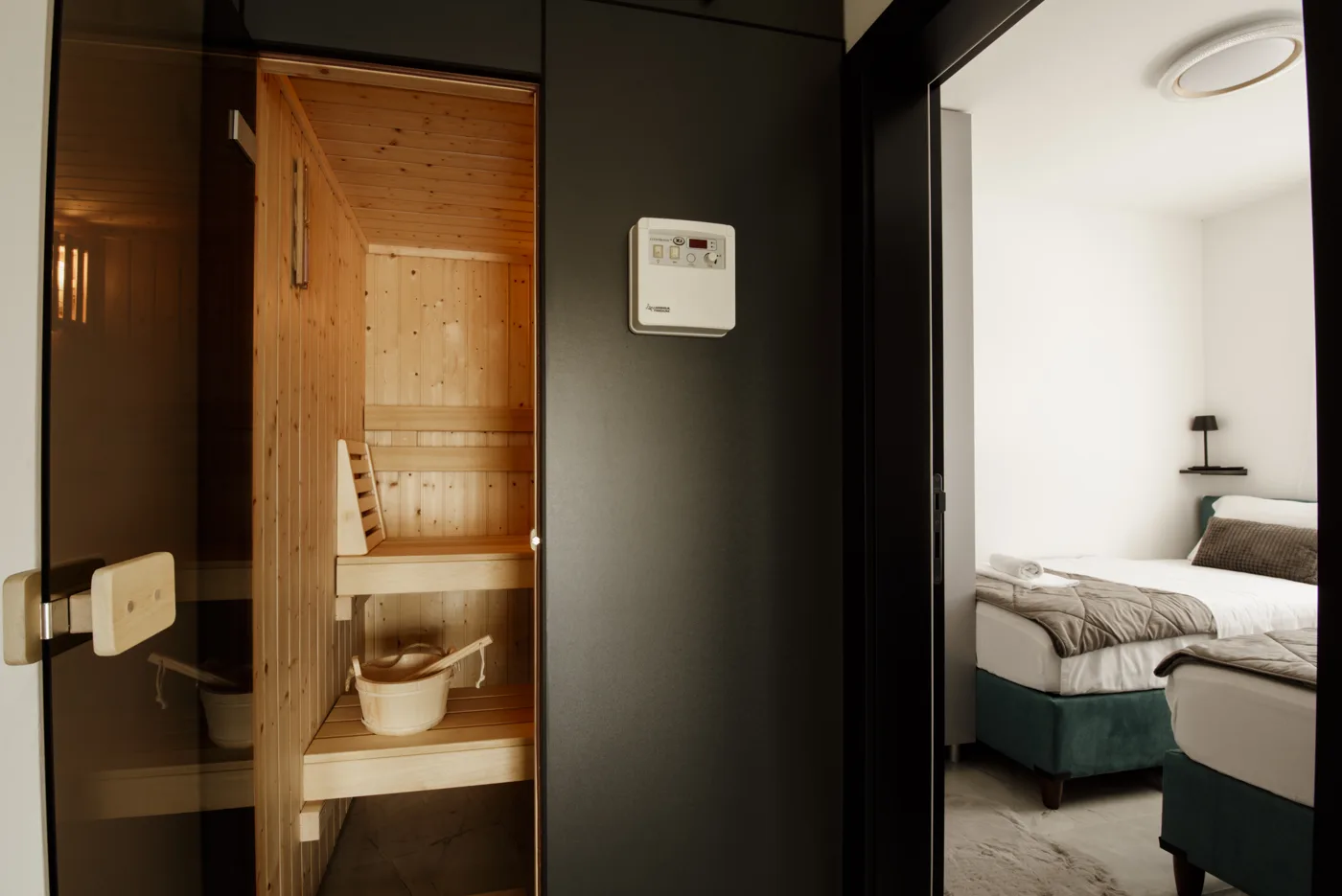
If you are asking what size sauna heater you need, the starting number is simple: 1 kW of heater output per cubic metre of sauna room volume. That is Harvia’s own stated rule, and the rest of the industry works from the same figure. A 2m by 2m room with a 2.1m ceiling is 8.4 cubic metres, so you begin at roughly 8 to 9 kW.
Then you adjust, and this is where people get it wrong in both directions. Undersize and the sauna never reaches temperature or takes two hours trying. Oversize and you get a room that heats fast but unevenly, with a heater cycling on and off and stones that never get properly saturated with heat.
Step 1: calculate the volume correctly
Length x width x height, in metres, including the space above and below the benches. The whole room is being heated, not just the bit you sit in.
Two common errors:
- Sloping ceilings. Use the average height, not the highest point.
- Barrel saunas. The curved section means the volume is meaningfully less than length x width x height of the bounding box. Manufacturers of barrel saunas normally state the effective volume; use theirs.
Ceiling height matters more than people expect, and lower is better. A sauna ceiling should ideally sit around 2.1m. Every extra 100mm adds volume you have to heat and puts the hot air further above your head, which is where it stays.
Step 2: add for cold and heat-storing surfaces
Harvia’s guidance is that “an average of 1 kW of heater power is required per cubic meter of sauna volume”, and that the requirement increases where the room has “window or glass surfaces” or “heat-storing materials such as brick or concrete”.
The mechanism is straightforward. Timber-lined, insulated panels reflect heat back into the room. Glass, tile, brick, stone and concrete either lose it or absorb it, and both cost you.
The adjustment is applied by inflating the calculated volume rather than by adding kilowatts directly. Manuals commonly instruct you to add somewhere between 1.2 and 1.5 cubic metres of notional volume per square metre of uninsulated surface, and the exact multiplier varies by manufacturer. Some US-market documents express the same thing as two cubic feet per square foot of cold surface.
Because the figure genuinely differs between makers, do not take a number off a blog, including this one, and commit to it. Find your specific heater’s installation manual and use its multiplier. What is consistent across all of them is the direction and the rough magnitude, and that is enough to tell you whether a full-glass front is going to push you up a heater size.
The door is normally excluded from this calculation, so a glass door alone rarely changes the answer. A glass front wall almost always does.
Worked example. That 8.4 m³ room, given a 2 m² glass panel, becomes roughly 10.4 to 11.4 m³ of notional volume. You have moved from an 8 or 9 kW heater to a 10.5 kW one on the strength of one window.
Step 3: check the heater’s own stated room range first
Every electric heater is sold with a manufacturer-stated minimum and maximum room volume, and those two numbers are the ones that actually matter. They already account for the heater’s element layout and stone capacity.
Do not ignore the minimum. Putting a large heater in a small room is not a safety margin, it is a design fault. An oversized heater reaches the thermostat’s cut-out quickly, shuts down, and leaves the stones without enough sustained heat to give good löyly when you throw water. You get a hot, dry room that produces a burst of steam and then nothing. Sitting inside the stated range beats being generous.
Step 4: check the electrics before you buy anything
This is the step that most often changes the decision, and it is much cheaper to discover now.
A UK sauna heater must be hardwired by a qualified electrician onto its own dedicated radial circuit. There is no plug-in option at these outputs, and the work is notifiable under Part P in England and Wales, meaning you need an Electrical Installation Certificate at the end.
Typical requirements scale roughly like this:
| Heater output | Room size | Circuit | Cable |
|---|---|---|---|
| 4.5 kW | around 3 to 5 m³ | 20 A | 4.0 mm² |
| 6 kW | around 5 to 8 m³ | 32 A | 6.0 mm² |
| 8 to 9 kW | around 8 to 12 m³ | 40 A | 10.0 mm² |
Two specifics from BS 7671 Section 703 that catch people out:
- Cable inside the sauna room must withstand high temperatures. Regulation 703.512.2 requires insulation and sheaths rated to a minimum of 170°C in the upper zone. Standard 70°C PVC twin and earth is not acceptable inside the room. Silicone rubber cable is the normal answer.
- Socket outlets are not permitted in the location containing the heater, and lighting switches go outside the room.
Then there is house capacity, which is the real constraint in most British homes. A 9 kW heater on a 230 V single-phase supply draws around 39 A on its own. Most UK homes have a 60 to 63 A main fuse for everything. That is why the working rule of thumb is that 9 kW is about the practical single-phase ceiling for a domestic property, not because larger heaters cannot run on single phase, but because your incoming supply cannot comfortably carry them alongside a shower and an oven.
If your calculation lands above 9 kW, you have three options: reduce the room volume, reduce the glass, or get a supply upgrade quoted before you commit. Have that conversation with an electrician before ordering the heater.
Wood-burning stoves size differently
If you are going wood-fired, the kW-per-cubic-metre rule does not transfer. Wood stoves are sold against a stated room volume range directly, and the sizing is driven by firebox volume and stone capacity rather than a power rating you can calculate.
The relevant constraints there are the flue, the required clearances to combustibles, and whether you are in a smoke control area. Those decide the project more than the sizing does.
Getting it right in practice
- Measure the room and calculate volume in cubic metres.
- Multiply by 1 to get a baseline kW.
- Measure any glass, tile, brick or stone surfaces and inflate the volume per your chosen heater’s manual.
- Shortlist heaters whose stated room range brackets that figure, and check you are not below the minimum.
- Take the heater’s data plate rating to an electrician before ordering, and confirm both the circuit and the incoming supply.
- Size ventilation separately. It affects how the room feels far more than an extra kilowatt does, and our sauna ventilation calculator sets out the intake and extract positions.
Once you have the size, choosing between models is a different question, and largely about stone capacity and control. Our sauna heater guide covers the types, Harvia versus HUUM compares the two brands people most often shortlist, and the best sauna heaters in the UK narrows it further. If you are still at the room stage, how to build a sauna covers the insulation choices that determine this calculation in the first place.
Frequently asked questions
What size sauna heater do I need for a 2m x 2m sauna? A 2m by 2m room with a 2.1m ceiling is 8.4 cubic metres, so the baseline is roughly 8 to 9 kW at 1 kW per cubic metre. Add notional volume for any glass or tiled surfaces, which can push a room that size to a 10.5 kW heater if it has a large glass panel.
Is it better to oversize a sauna heater? No. Every heater has a stated minimum room volume as well as a maximum, and going below the minimum means the thermostat cuts out before the stones have absorbed enough heat. The result is a hot, dry room that gives one burst of steam and then nothing. Sit inside the stated range.
Can I run a sauna heater from a normal plug socket? No. Sauna heaters must be hardwired onto a dedicated radial circuit by a qualified electrician, and the installation is notifiable under Part P in England and Wales. Cable inside the room also has to be rated to at least 170°C in the upper zone, so ordinary PVC twin and earth is not suitable.
Do I need three-phase power for a sauna? Usually not below about 9 kW. A 9 kW heater draws around 39 A on a 230 V single-phase supply, and most UK homes have a 60 to 63 A main fuse for the whole property, so that is roughly the practical domestic ceiling. Above it, get your supply assessed before ordering.
How much does glass in a sauna affect heater size? Considerably. Glass loses heat rather than reflecting it, so installation manuals tell you to add notional volume, commonly between 1.2 and 1.5 cubic metres for each square metre of uninsulated surface. A full glass front can move you up a whole heater size; a glass door on its own usually does not, as doors are normally excluded.
Does ceiling height change the heater size I need? Yes, directly, because volume is what you are heating. A sauna ceiling around 2.1m is the usual target, and every extra 100mm adds volume while pushing the hottest air further above the bench. Lowering a ceiling is often cheaper than moving up a heater size.
More from Baltic Spa
 Reviews
The Best Public Saunas in London for 2026, Tested and Ranked
We tested and ranked the best public saunas in London for 2026, from £9.50 community baths to Canary Wharf's 60-person contrast therapy hall.
 Infrared Saunas
Infrared Sauna Blankets: How They Work and Who They Suit
How an infrared sauna blanket works, what the layers and EMF claims really mean, who they suit and who should avoid one, from an evidence-first UK guide.
Sauna Stones Calculator: How Many Kg of Stones Do You Need?
Free sauna stones calculator: enter your electric heater's kW or your wood stove size and get the recommended stone weight in kg, plus how many boxes to buy.