Harvia vs HUUM: Stone Load, Controllers and UK Wiring
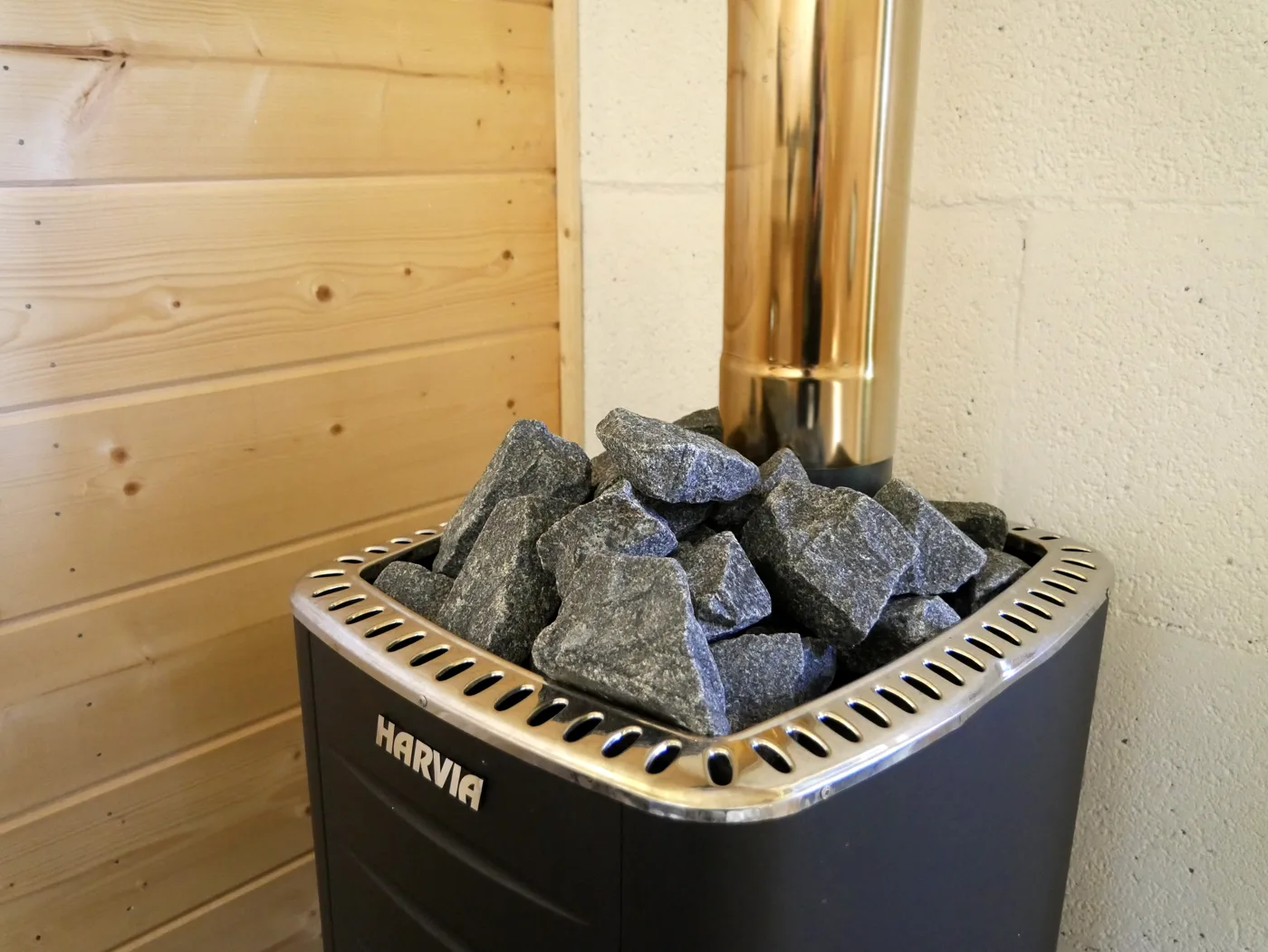
Harvia vs HUUM is usually written up as Finnish reliability against Estonian design, which is true and almost useless when you are trying to specify a heater for a 6 cubic metre cabin in a British garden. The differences that actually change your build are three: how much stone the heater carries, whether the controller comes with it, and what electrical supply it demands.
Take those in turn and the choice generally makes itself.
The short version
Harvia has been making sauna heaters in Finland since 1950 and sells the widest range of anyone: wall-mounted, pillar, wood-burning, tiny and enormous. Many models have the timer and thermostat built into the heater, so there is nothing else to buy. Spares and dealer support in the UK are the best in the category.
HUUM is Estonian, much younger, and builds heaters around the idea of burying the elements in a large mass of stone. Every electric HUUM requires the separate UKU control system, which is not an optional upgrade. The payoff is a softer, longer-lasting löyly and a heater that looks like an object rather than an appliance.
Stone load is the real difference
This is the specification most people skim past and it determines what your sauna feels like.
Stones store heat. More stone mass means the temperature drop when you throw water is smaller and the steam is gentler and lasts longer. Less stone means a sharper, drier hit and a faster recovery from the elements themselves.
The published figures, from each manufacturer:
| Heater | Output | Stones | Room size |
|---|---|---|---|
| Harvia Cilindro PC70 | 6.8 kW | 80 kg | 6 to 10 m³ |
| HUUM DROP | 4.5 to 9 kW | 55 kg | 3 to 13 m³ |
| HUUM HIVE Mini | 6 to 10.6 kW | 150 kg | 5 to 16 m³ |
| HUUM HIVE | 12 to 18 kW | 250 kg | 12 to 28 m³ |
Read the HIVE Mini row again. At 9 kW it holds 150 kg of stone, roughly double what a Harvia pillar heater of similar output carries, in a comparable footprint. That is the whole HUUM argument in one number, and if löyly quality is your priority it is a real one.
Two caveats stop this being a clean win. First, Harvia’s pillar heaters like the Cilindro carry far more stone than its wall-mounted models, so comparing the entire brand to HIVE is unfair; compare like for like. Second, a big stone mass takes longer to heat from cold, which matters if you sauna spontaneously rather than on a schedule.
The full HIVE, at 12 to 18 kW and rooms up to 28 m³, is a commercial-scale heater. It is not the answer for a domestic garden cabin, and seeing it recommended in home sauna articles is a good test of whether the writer has read a spec sheet.
Controllers: one brand includes them, one does not
HUUM: the UKU is compulsory and separate. Every electric HUUM heater runs on the UKU control system, sold as an additional item, with a control panel included in the set. UKU is genuinely good, with app control and remote preheating built in, but you must budget for it and your electrician must wire it in. Sensor and controller siting need planning before the cabin is lined.
Harvia: often integrated, sometimes not. The Cilindro PC70, for example, has an integrated timer and thermostat and needs no external unit. Other Harvia models in the same family are built for a separate controller, and the model code tells you which: broadly, an E suffix means it expects an external control unit. Harvia’s own app control comes via the Xenio WiFi unit and the MyHarvia app.
Practical consequence: a HUUM quote that looks close to a Harvia quote is usually not, once the UKU is added. Compare complete systems, not heaters.
The UK electrical question
This is where British installs come unstuck, and it is worth understanding before you fall in love with a heater.
Most UK homes have a single phase 230V supply. Sauna heaters are among the largest fixed loads a domestic property will ever carry. Harvia’s published figures for the 6.8 kW Cilindro PC70 make the point: on 400V three phase it needs 3 x 10 A fuses and a 5 x 1.5 mm² cable; on 230V single phase it needs a 1 x 35 A fuse and a 3 x 6 mm² cable.
That single-phase requirement is a dedicated 35 A radial circuit, in 6 mm² cable, from your consumer unit. Whether your board and incoming supply can take it depends on your house, and it is the first thing to check, before the cabin, before the benches, before the brand.
Rules of thumb for planning:
- Up to about 6 kW is usually achievable on a single phase domestic supply with a properly sized dedicated circuit.
- Between 6 and 9 kW, get an electrician to assess the whole installation, not just the circuit.
- Above 9 kW you are generally into three phase, which most UK homes do not have and which is expensive to bring in.
Because heater output is dictated by room volume, this often works backwards: your supply caps your heater, and your heater caps your cabin size. Our guide to what size sauna you need sets out the volume calculation, and it is worth doing before you specify anything.
One more thing: heaters sold into North America are listed at 240V split phase. If you are reading specifications on a US retailer’s site, the fusing and voltage figures do not apply here. Confirm the UK or EU variant with the distributor.
Where each one wins
Choose Harvia if:
- you want the widest choice of sizes, shapes and fuel types, including wood-fired
- you would rather not buy and wire a separate controller
- long-term spares and UK dealer support matter to you, which for a heater you plan to keep 15 years they should
- you are working to a tight budget and want the money in the cabin rather than the heater
Choose HUUM if:
- the quality of the steam is the point of the whole project
- you want a heater that looks deliberate in a small, well-finished cabin
- you are happy to specify and pay for the UKU system, and you value its app control
- you heat on a schedule, so a longer warm-up from a big stone mass costs you nothing
Choose neither if your electrical supply cannot support the output your room volume needs. Fix that first. A heater that is undersized for the cabin never gets it properly hot, whichever badge is on the front.
Things people get wrong with both
Loading the stones badly. Stones go in loosely, largest at the bottom, never packed tight, and never wedged against the elements. Restricted airflow is the commonest cause of an element failing early on either brand.
Reusing old stones. Stones crumble. Check them annually, and replace any that have split. It costs almost nothing and restores performance people assume they have lost forever.
Buying on kW alone. Two 9 kW heaters with 55 kg and 150 kg of stone give noticeably different bathing experiences, and both are correct for someone.
Skipping the ventilation. Neither brand can compensate for a cabin with no air path. Get the inlet and outlet right at build stage, covered in how to build a sauna.
If you are still deciding on heater type rather than brand, start with our sauna heater guide and the shortlist in best sauna heaters UK.
Frequently asked questions
Is HUUM better than Harvia? Neither is better across the board. HUUM carries far more stone for a given output, which gives softer, longer-lasting steam, and its heaters look better. Harvia offers a much wider range, often includes the controls in the heater, and has stronger UK spares and dealer support. Match the strength to what you actually care about.
Do HUUM heaters need the UKU controller? Yes. Every electric HUUM heater requires the UKU control system, bought separately, with the control panel included in the set. Factor it into both the budget and the wiring plan from the start.
How much stone does each heater hold? By the manufacturers’ own figures: Harvia’s Cilindro PC70 takes 80 kg, the HUUM DROP takes 55 kg, the HIVE Mini takes 150 kg and the full-size HIVE takes 250 kg. Wall-mounted heaters from either brand hold considerably less than pillar models.
What electrical supply do I need for a sauna heater in the UK? A dedicated circuit sized to the heater. Harvia specifies a 35 A fuse and 6 mm² cable for a 6.8 kW heater on a 230V single phase supply. Around 9 kW and above you are usually looking at three phase, which most UK homes do not have. Have an electrician assess your supply before you choose a heater.
Which brand is better for a small garden sauna? For a typical 4 to 8 m³ British garden cabin, both work. The HUUM DROP and Harvia’s pillar heaters are the natural candidates at that size. If you want the simplest install, a Harvia with integrated controls has fewer moving parts; if you want the best steam in a small room, the HIVE Mini carries an unusual amount of stone for its footprint.
Are spare parts easy to get in the UK? Harvia has the deeper UK dealer network and the longer history here, so elements, stones and controllers are generally straightforward to source. HUUM is well supported through its UK distributors, but the network is smaller. If you are in a remote area, ask your supplier directly how they handle a failed element in January.
More from Baltic Spa
 Reviews
The Best Public Saunas in London for 2026, Tested and Ranked
We tested and ranked the best public saunas in London for 2026, from £9.50 community baths to Canary Wharf's 60-person contrast therapy hall.
 Infrared Saunas
Infrared Sauna Blankets: How They Work and Who They Suit
How an infrared sauna blanket works, what the layers and EMF claims really mean, who they suit and who should avoid one, from an evidence-first UK guide.
Sauna Stones Calculator: How Many Kg of Stones Do You Need?
Free sauna stones calculator: enter your electric heater's kW or your wood stove size and get the recommended stone weight in kg, plus how many boxes to buy.